
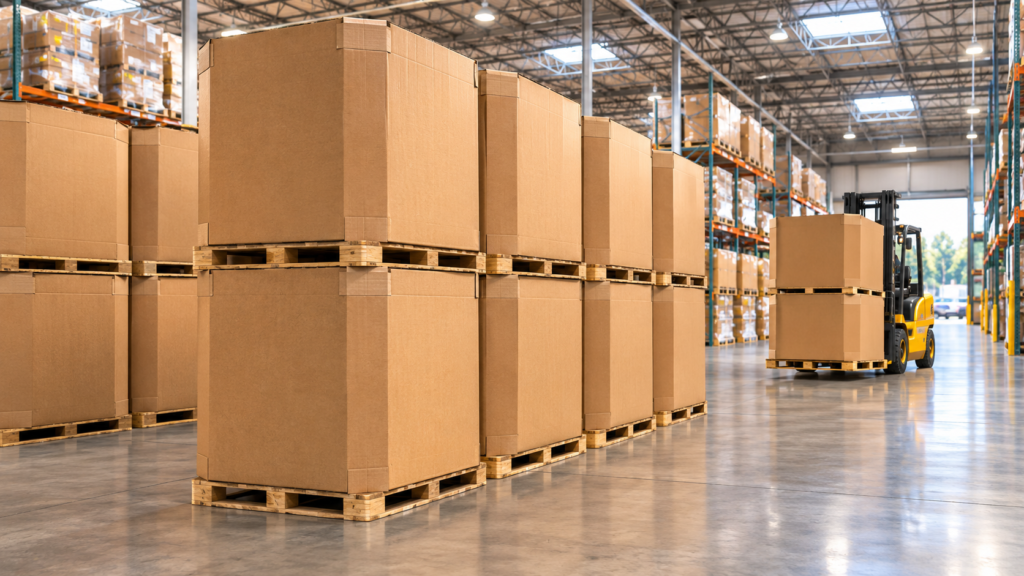
Gaylord bulk boxes are the backbone of bulk storage and shipping. Instead of paying new-box prices every cycle, you buy graded, heavy-duty boxes you can load, ship, empty, and reuse. But a reusable box only saves you money if it is the right size and wall strength for your load. This guide covers every standard size, what the ply numbers mean, how much weight each box holds, and how to pick a Gaylord bulk box you will actually get multiple trips out of.
What “Gaylord Box Dimensions” Actually Mean
Gaylord box dimensions are written as Length × Width × Height, in inches. A few things are worth knowing before you compare numbers:
- Inside vs. outside. Sizes are usually quoted as the inside usable dimensions. The outside is slightly larger depending on how thick the walls are — important when you are checking pallet fit or trailer cube.
- The footprint is built around the pallet. Almost every Gaylord is designed to sit on a 48″ × 40″ GMA pallet, the most common pallet in North America. On our listings you will see this footprint written as 40 × 48, followed by the height.
- Why pallet fit matters. A box that overhangs the pallet gets crushed at the edges and shifts in transit. A box that is too small wastes floor space and tips under a forklift. Matching the footprint keeps your stacks square, stable, and easy to move.
Reusable Gaylord Box Sizes & Dimensions
The footprint stays the same (40″ × 48″); the height is what changes based on how much volume you need. Here are the standard sizes we stock:
| Dimensions (W × L × H) | Approx. Volume | Best for |
|---|---|---|
| 40 × 48 × 25 | ~28 cu ft | Short, dense loads — produce, metal turnings, “watermelon” boxes |
| 40 × 48 × 30 | ~33 cu ft | Medium loads where a half-height box saves freight |
| 40 × 48 × 40 | ~44 cu ft | The everyday workhorse size |
| 40 × 48 × 41 | ~46 cu ft | HPT41-style boxes |
| 40 × 48 × 42 | ~47 cu ft | General bulk storage and recycling |
| 40 × 48 × 48 | ~53 cu ft | Tall, high-volume loads — “Amazon” style boxes |
The industry baseline many buyers know is roughly 48 × 40 × 36, but in practice the height you need depends entirely on your material and how it is handled. Browse what is in stock on the Shop by State page to see current sizes and prices near you.
Gaylord Box Wall Thickness: What 2, 3, 4, 5 & 8-Ply Mean
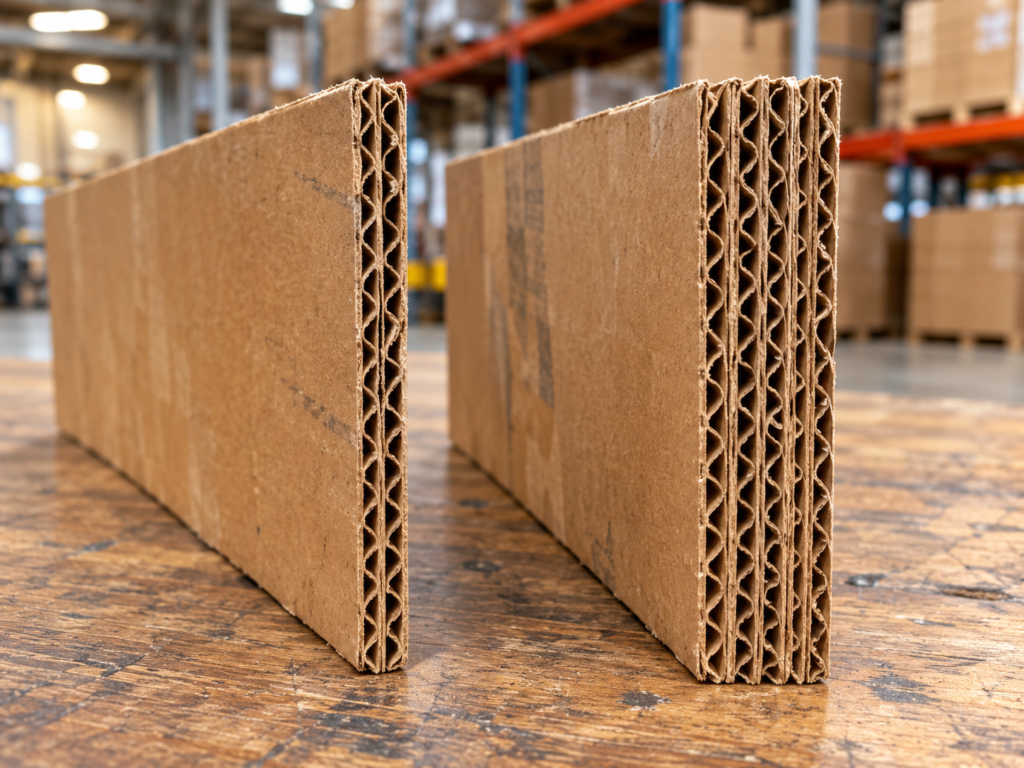
After size, gaylord box wall thickness is the single biggest factor in how much a box can hold. “Ply” means the number of corrugated walls built into the board: more walls, more strength, more weight capacity — and a higher price. Pick the lightest wall that safely carries your load, and you stop paying for strength you do not use.
- 2-Ply (double wall) — The lightest-duty option. Great for lighter, bulky, non-dense materials and short-term use.
- 3-Ply (triple wall) — The workhorse of the industry. The right balance of strength and cost for most warehouse and recycling jobs.
- 4-Ply — A step up for heavier or denser loads that need extra stacking strength.
- 5-Ply — Heavy-duty. Built for dense scrap, parts, and demanding stacking.
- 8-Ply — The strongest wall we carry, for extreme or very dense loads where failure is not an option.
Two technical ratings describe this strength on a spec sheet: ECT (Edge Crush Test — stacking strength) and burst strength (resistance to a punch-through). You do not need to memorize them, but higher numbers mean a tougher box.
Gaylord Box Weight Capacity: How Much Can One Hold?
This is the question that matters most, and the honest answer is: it depends on the specific box. There is no universal rule that ties a fixed weight to a wall count, so always confirm the rating on the box you are buying. That said, here is realistic guidance by wall type:
- 2-ply: roughly up to 1,000–1,500 lbs for most loads
- 3-ply: commonly 1,500–2,500 lbs
- 4-ply: around 2,000–2,800 lbs
- 5-ply: around 2,500–3,000 lbs
- 8-ply: 3,000 lbs and up for extreme loads
Watch out for bottom blowout. The most common failure is the bottom giving way and dropping the contents on the floor. It usually happens when a box is filled to its volume with a dense material — metal, aggregates, dense plastics — long before it looks full. For dense products, weigh the load, do not just eyeball it. And if you are wondering whether a used box can take the punishment, it can: see why used Gaylords handle the same volume in recycling logistics.
How to Choose the Right Gaylord Box (Quick Checklist)
- Weigh your typical load — know the pounds per box, not just the cubic feet.
- Check density — dense materials hit the weight limit long before the box looks full.
- Match the pallet — stick with the 40″ × 48″ footprint so stacks stay square and forklift-safe.
- Plan your stack height — the higher you stack, the more ECT (wall strength) you need.
- Decide new vs. used — if your product does not require FDA-compliant new packaging, graded used boxes cut cost without losing strength. Compare in Used vs. New Gaylord Boxes.
- Pick the ply to match — lighter loads, fewer walls; dense or tall stacks, more walls.
- Confirm the box’s rating before you commit to a large order.
Gaylord Box Types and Their Dimensions
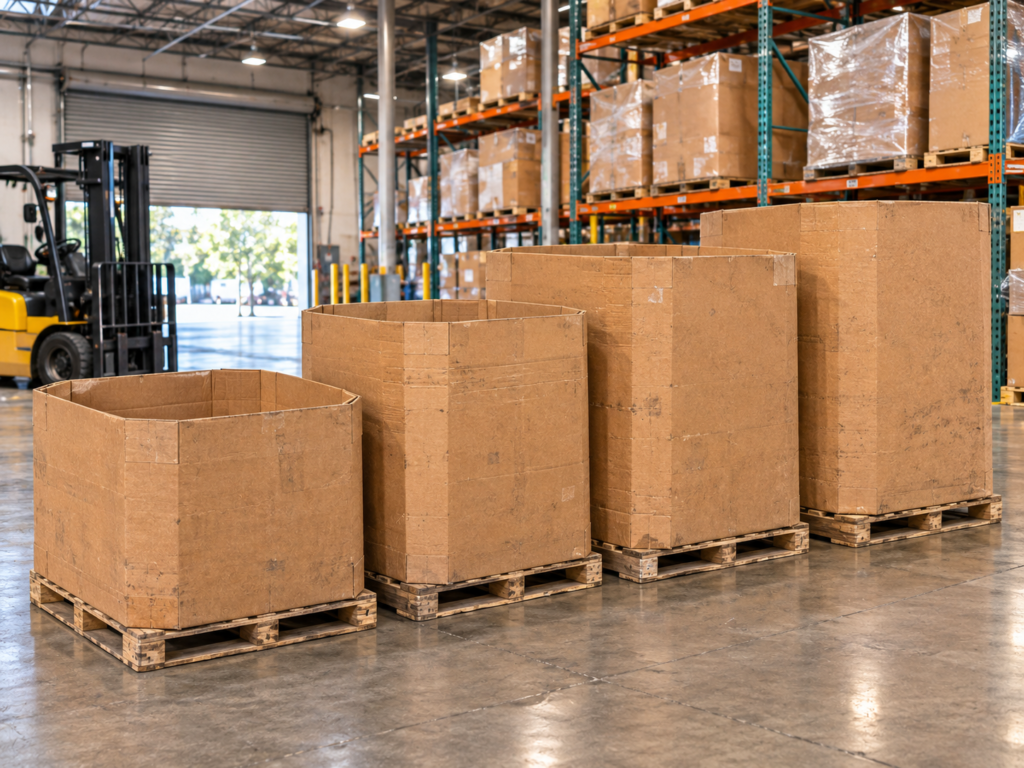
We stock several box types, each suited to a different job:
- Resin — strong, clean boxes popular for plastics and resin pellets.
- 3 Walls — the triple-wall workhorse for general bulk and recycling.
- Watermelon — short (around 40 × 48 × 25), built for produce and dense loads.
- Spacekrafts — heavy-duty boxes for demanding stacking.
- Amazon — tall (around 40 × 48 × 48) for high-volume, lighter loads.
- HPT41 — the 41″-tall option for balanced volume and strength.
Where to Buy Reusable Gaylord Boxes Near You
The Gaylord Box Guy has been buying and selling reusable Gaylord boxes since 2014. Every box is graded, so you get dependable, multi-use strength at a fraction of new-box pricing — in the exact size and wall thickness your operation needs. We stock Gaylord bulk boxes in San Diego, San Jose, Los Angeles, Houston, Cd Juarez, and Tijuana, with local inventory that skips the long-haul freight bill.
- Got a size in mind? Request a quote and we will match you to in-stock inventory.
- Sitting on empties? We buy too — sell your Gaylord boxes for cash.
Call (619) 638-2483 or email luis@thegaylordboxguy.com.
The Gaylord Box Guy has been buying and selling reusable Gaylord boxes since 2014. Every box is graded, so you get dependable, multi-use
Reusable Gaylord Boxes: FAQ
What is the standard Gaylord box size? Most Gaylord boxes are built on a 48″ × 40″ footprint to fit a standard GMA pallet. A widely known baseline is about 48 × 40 × 36, but height varies by use — we stock heights from 25″ up to 48″.
How much weight can a Gaylord box hold? It depends on the wall construction. As a rule of thumb, double-wall (2-ply) boxes handle lighter loads, triple-wall (3-ply) commonly carry 1,500–2,500 lbs, and heavier 5- and 8-ply boxes go well beyond that. Always confirm the rating on the specific box and weigh dense loads.
What does 2-ply or 3-ply mean? It is the number of corrugated walls in the box. More plies mean more strength, more weight capacity, and a higher price.
Are used Gaylord boxes as strong as new ones? Graded used boxes hold their shape and stacking capacity for demanding jobs like scrap metal and e-waste. Unless you need FDA-compliant new packaging, used is the cost-smart choice.
What size Gaylord fits a standard pallet? The 40″ × 48″ footprint sits flush on a standard 48″ × 40″ GMA pallet with no overhang — the setup that keeps stacks stable and forklift-safe.